The Comfort of the Apocalypse
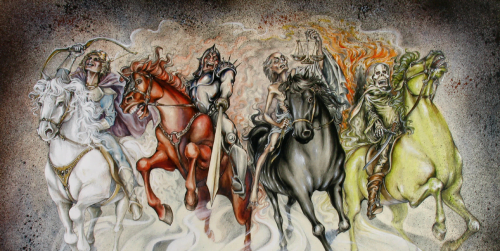 Jonathan Parker writes: Did somebody say, "Apocalypse?"
When things get dire, equally in our current, terrifying pandemic, I hear the word "apocalypse" come upwards a lot more oftentimes. "Religious" people start saying, "Hither it is" or "No, this isn't it" (often you can guess which based on their given political or cultural background).
The "it" they hateful is the cataclysmic "end of the world." And they aren't the only ones. When many of united states of america think of what is already here and what is yet to come, it'south hard not to feel like the strings holding the globe together are slipping.
Mayor Francis Suarez of Miami, himself a recent survivor of COVID-19, recently looked at the dwindling resources of his poorest citizens and suggested more authorities action was immediately needed. Without information technology, he idea, the best word to capture the situation would be "apocalyptic."
"If we don't take dramatic steps to make certain that we alleviate some of the more pregnant financial burdens in people'southward lives, my fearfulness is it could get apocalyptic." he said.
"Apocalyptic? You really hateful that?" queried the interviewer.
"Yes, I mean, you have to understand that, in a urban center similar Miami, we — after 9 days, yous know, without power, when in that location's a hurricane, it gets — it can get pretty apocalyptic."
Most of us reading blogs are well aware that our relative levels of peace and prosperity are not available to everyone in our communities or around the world. Nosotros work hard to create a earth where those left out have increasing access to food, shelter, justice, and security.
But when a massive, seemingly-unstoppable forcefulness—especially one that is unseen—similar this virus hits us, it can experience like everything nosotros know is coming undone. Nosotros think we'rethe hope for others,who rightly want to know the kind of health and security nosotros have. And if ours is falling apart, what's going to be left? Will we see decease and suffering like the earth has never seen?
"Apocalyptic" feels similar the just discussion for it.
My wife is an ICU nurse, and for weeks at present our collective heart rate has been revving at a higher level than usual. Thankfully, different many others, her hospital seems relatively well-supplied. She has her PPE, and she is well-trained. Just every day that she goes to work, caring for COVID and non-COVID patients akin, I tin't aid but experience a keener sensation of our bloodshed. On her days off, I feel a little more reason to "count our days" (Psalm 90:12) and let the little everyday joys "soak in" a flake more. We never know when they will exist our terminal ones.
This is of course true for all of us, all the fourth dimension, and the Coronvirus pandemic has got us all thinking just a footling bit more almost what our time on this earth is for—and how long it might last. Simply, it's only at this point that I recall the world "apocalyptic" has something else to say to us. 1 that I have been leaning into these days. 1 I would like to share:
For those who wrote them, apocalyptic writings were a condolement. And what they knew almost God tin can comfort united states of america, too. Since it's Holy Week, let me explain by starting with Jesus'south version of this.
Jesus's "Little Apocalypse"
Somewhere during this Holy Week some 2000 years ago (between Palm Sunday and the Last Supper), Jesus took a moment to sit with his disciples on the Mount of Olives, overlooking the Jewish Temple. There, Jesus gave one of his famous sermons, oft called his "Piddling Apocalypse" by scholars (Matthew 24-25; Marking 13; Luke 21). My students laugh when I tell them the championship: "How can you take a 'picayune' cease of the world?"
What I get to explain to them is that anapocalypse is dissimilar from theapocalypse.
Apocalypse (from the Greek word apocalypsis) really means "revelation." (Yep, similar the book of Revelation.) It doesn't merely depict an event but a specific kind of prophetic writing.
The Book of Revelation, by the Christian prophet John, is just one example of a much wider genre of biblical (and fifty-fifty extra-biblical) literature known equally "apocalyptic." Most famously represented in the Bible in Daniel seven-12, apocalyptic literature is (to infringe from Yale skilful, John J. Collins) an ancient Jewish form of writing that depicts a "transcendent reality … intended to interpret present earthly circumstances in lite of the supernatural world."
This emphasis on the transcendent can also be seen in earlier forms in places like Isaiah 24-27 and Joel 2:28-32 and in non-biblical texts similar one Enoch. In each example, the language there will audio strangely familiar for anyone who has read or heard Jesus's words in places like Marking 13:vii-8 (NRSV),
7 When you lot hear of wars and rumors of wars, do not be alarmed; this must accept place, only the end is still to come up. 8 For nation volition ascension against nation, and kingdom against kingdom; there volition be earthquakes in various places; at that place will be famines. This is but the beginning of the nativity pangs.
It's language from this kind of writing that Jesus is using in his sermon. (Run into Ian Paul'due south video here for more.) We often remember of Jesus as the one prophesied most, but in the early on days of the Jesus movement, his role every bit one who prophesiedwas arguably even more important. Just why is Jesus prophesying in this way and how could information technology aid u.s. now?
Apocalyptic Comfort
One of import attribute of this writing (sometimes overlooked or unknown) is that it was ofttimes written as a form of comfort to those indelible great trials, especially oppression and persecution. The writers of ancient apocalypses wanted their readers to know that God is merciful, but He is also adamant non to let evil win (cf. Exodus 34:6-vii). Correct when the goodness of God seems questionable—or downright absent—an apocalypse says, "This is difficult, but in the finish, everything will exist ok. I am not finished, yet."
In Daniel's globe (no matter how i parses the dating of that book), it was hardship nether an oppressive empire. The prophet John of Revelation was speaking to churches who were undergoing various merely widespread persecutions in their communities (hence, the letters in chapters 1-3). In the Gospels, Jesus takes up this kind of linguistic communication before his Last Supper in order to comfort his disciples ahead of the devastation of the Temple which would strike them in merely a few decades' time in 70 CE.
While on the Mount of Olives, Jesus once again reiterated an of import merits of the last calendar week of his earthly ministry building (cf. Matthew 24:2; Mark thirteen:2; Luke xix:43-44; 21:five-7): Nether God's judgment, the Temple is going to autumn.
The thing is, this had already happened. Some 600 years earlier, nether the Babylonians, the famed Nebuchadnezzar had come—non in one case but twice in 597 and 587 BCE—and plundered the Temple's wealth and Jerusalem'due south populace (2 Kings 24). And like almost Jews of their day, the disciples probably felt similar this wasthe Lord'southward judgment on them. The "twenty-four hours of the LORD" (cf. Zephaniah one; Amos 5), as information technology was known, was already behind them. Maybe "the nations" still accept "theirs" coming to them (cf. Isaiah 13; Jeremiah 26; Obadiah fifteen), but not "us," right Jesus?
But, according to the Gospels, Jesus knew a worse mean solar day wascoming, a mean solar day that would be completely disorienting to the disciples and to the whole Jewish nation. He also knew it wouldn't be the final one. In each of these Gospels' accounts, he goes on to describe, in apocalyptic language, the pattern of the times to come, when non just State of israel, but the whole globewould rock and reel nether the sufferings of pestilence, war, and famine. But in the stop, he would come and so in that location would exist "the terminate of the world" as we know it. Every bit Luke 21:25-27 puts it (NRSV):
25 "There will be signs in the sun, the moon, and the stars, and on the earth distress among nations confused by the roaring of the sea and the waves. 26 People will faint from fright and foreboding of what is coming upon the world, for the powers of the heavens volition be shaken. 27 And so they will see 'the Son of Man coming in a deject' with power and great glory.
Jesus knew that when we striking what we are now going through, what we would need is not fearfulness but comfort. Only that comfort could non come through confidence in ourselves; instead, we would demand to have something truly transcendent to promise in. That's why he preached the way he did. When nosotros think the strings belongings the globe together are slipping under the strain of our creaturely frailty, it's and so that we can go a glimpse of what really holds creation together in the starting time place. And information technology's not us.
Apocalyptic Vision
When the world looked disorienting and unpredictable, apocalyptic writers took upwards their pens to draw the earthly chaos every bit a mere outworking of more powerful "heavenly" forces. Things may look bad "down here," but that's only because nosotros don't see what's happening "up there." Battles between God and the forces of evil have not nonetheless resolved in the favor of the 1 who will win; that'due south why things are harsh right at present.
"On that day the LORD will punish the host of heaven in heaven," says Isaiah 24:21 (NRSV), "and on earth the kings of the earth." The battle isn't over until the God of heaven sings His victory song. Sensing their own prophetic burden to speak this comfort, the biblical prophets write to reveal what's reallygoing on "backside the scenes."
And nonetheless, readers of books similar Revelation and Daniel oft accept a much more befuddling reading experience. The text doesn't seem to explain "what'due south really going on" every bit much every bit brand things confusing: Daniel describes "four swell beasts [that] came up out of the body of water … the first was similar a panthera leo and had eagles' wings [merely] its wings were [soon] plucked off" (seven:3-iv, NRSV). Joel 2:xxx talks about "portents in the heavens and on the earth, blood and fire and columns of smoke" (NRSV). Some of Revelation's images are as well unclear to draw visually (east.g. How are Revelation xiii:one 'southward "ten horns" distributed across "seven heads" anyway?). The intensity of the visual imagery is oftentimes matched only by its incoherence to our material sensibilities.
Well-nigh of the fourth dimension, this is because what the writer is depicting are symbols (Daniel even explains his later in the chapter, Dan vii:xv-27), and oft the symbols are piled ane upon another. Their obscure nature does non mean we cannot know what the passages intended to communicate but that i must read, reflect, observe, and think about the text before i tin understand.
More than to the signal, these are the virtues the reader needs non only for making sense of the text but for making sense of their perplexing, terrifying times. Rather than fear—or rather because of our fright—apocalypses say we ought to stop and consider why our world is in the state that it is. The prophets would argue that the kind of reflection nosotros need is not more data (as helpful equally that might exist in some firsthand intendance-giving and decision-making contexts) only more prayer. God lone knows and has given—and is giving—revelation, if we will seek him.
But perhaps fifty-fifty more comforting than this is the Bible reader'southward feel if one merely keeps on reading. There are indications that apocalyptic literature was not just written to be read silently but to exist performed aloud (detect Revelation 1:3 "Blest is the one who reads aloudthe words of this prophecy…," accent added). I ofttimes recommend that my students listen to the Bible using a quality audiobook. One of the benefits of hearing a text read in its entirety is that you can become more than enlightened of the text'due south own emotional highs and lows than your ain questions and curiosities. In the case of apocalyptic works, the consistent result is that the reader/hearer can't help but be drawn throughthe ups and downs and then totheir ultimate decision: God e'er wins.
Apocalyptic End
At first, this affidavit, however, seems to exit u.s.a. out of the picture. What comfort or hope is there in God winning if we're left out in the common cold? Simply, this problem is overcome once we get to know the Bible's God. The prophetic literature of the Bible, in general, and maybe the apocalyptic literature in specific, emphasizes God's absolute solidarity with his creation (e.1000. His Spirit poured out on "all flesh," Joel 2:28).
Indeed, the not bad Jewish philosopher and biblical scholar Abraham Heschel has persuasively argued for "divine pathos," that "the God of the prophets cares for His creatures, and His thoughts are about the world. He is involved in human history and is affected by human acts." (This, of course, has to be balanced with a proper understanding of divine impassibility, one that supports Scripture's clarity on God's "divine passion," despite it not being fully analogous to our own.) As much as it depends on Him, and often despite our mistakes and sins, the God of the Bible volition notlet u.s. creatures go. "I will non forget y'all. See, I take inscribed you lot on the palms of my easily," Isaiah 49:16 (NRSV) reassures us, and Christian theology sees this verse fulfilled in Christ'due south Cross whenever we join past faith in the climax of hope in His Easter victory over death.
It was this sense of assurance of God'due south commitment to His creation, confirmed to her by her Christian organized religion, that filled mystical author and anchoress, Julian of Norwich. Born just before the start wave of the Black Death and writing in the midst of its continued recurrence, Julian had a confidence, through prayer and apocalyptic visions, to see the whole world including her beleaguered corner of information technology, from God'due south perspective. Her writings are the oldest surviving book of any woman in England, and in them, she sounds a lot similar the prophet Joel. In God, she has a reason beyond reason to exist hopeful. "All shall exist well," she extols, "and all manner of matter shall be well."
In these days, we need this kind of comfort, the apocalyptickind. During our current COVID-19 lives, some of us will come across unremitting loneliness, fear, and grief. Amid these, we will undoubtedly find ourselves praying with the Psalmist, "LORD sustain her on her sickbed! In her affliction, restore her to full health!" (Psalm 41:three, modified), or shivering in our closets (where our children can't meet) in utter terror of the "pestilence that stalks in darkness, … the devastation that wastes at noonday. A thou [falling] at [our] side, ten m at [our] correct mitt" (Psalm 91:6-7, NSRV). When nosotros practise, the experience will be new to us, merely the biblical prophets tell us, that as a people, we humans take been here before. And they would want us to mind to the birds in the trees, watch the clouds ringlet past, and know—as they did—that in the end, our time to come is not just with God, but God himself has pledged: His hereafter is with us. He will non requite upwardly on us.
"The home of God is among mortals.
He volition dwell with them;
they will be his peoples,
and God himself will be with them" (Rev 21:3, NRSV, emphasis added).
In that location is comfort in that apocalypse.
 Dr Jonathan Parker teaches Bible and theology at Berry College, Georgia, The states. He completed his Ph.D. in Former Testament at the University of Durham (England), with special emphasis on the Theological Estimation of Scripture. He is an ordained priest in the Anglican Church in North America.
If y'all enjoyed this, exercise share information technology on social media, maybe using the buttons on the left. Follow me on Twitter @psephizo.Similar my page on Facebook.
Much of my piece of work is done on a freelance basis. If you have valued this postal service, would you consideraltruistic £1.20 a month to support the product of this blog?
If y'all enjoyed this, practise share it on social media (Facebook or Twitter) using the buttons on the left. Follow me on Twitter @psephizo. Like my page on Facebook.
Much of my work is washed on a freelance basis. If you take valued this post, you lot can make a single or repeat donation through PayPal:
Comments policy: Adept comments that engage with the content of the mail service, and share in respectful debate, can add real value. Seek start to sympathise, so to exist understood. Make the most charitable construal of the views of others and seek to learn from their perspectives. Don't view debate as a disharmonize to win; address the argument rather than tackling the person.
mcalistertherited.blogspot.com
Source: https://www.psephizo.com/biblical-studies/the-comfort-of-the-apocalypse/
0 Response to "The Comfort of the Apocalypse"
ارسال یک نظر